HBOX vs SFAT Shine 2016
http://flowfeedback.com/feedback/WTXnfRnR5KgExCSpH
Reminder I still do these for $10 a game.
Game 1
BF
8:00 descending fair gets whiff punished
holy goodness that whole sequence of DI was pretttty bad lol, he kept going exactly where sfat could follow up
7:50 stalling over nair range for a spot to land, gets one then trades
7:47 interesting. Immediate fall through pounds at the DD spot, gets CCed though
7:45 lol look how confidently sfat presses down.
7:41 premeditated CC but sfat misses the grab for some reason
hbox is looking for one more aerial to break CC %
sfat confirms no approach then goes for a vertical hit
7:35 pretty ballsy/lazy ledgegrab lol
soooo lucky he didn’t die after that CC jab
7:31 sfat buffered a normal gettup so he gets punished, good DI off the bair though
7:29 lol what a whiff
hbox reads a dj option. sfat needed to delay his dj, which he wasn’t going to do there.
7:23 hbox avoids laser damage by matching inv, fox is going to get stage anyway
sneaks in an upair grab, I think sfat tried to CC but was too late so he walked into it
goes for dthrow trap, techchase, good spacing, regrab, idk why he chose to upthrow that time. I think a second dthrow was better. Oh my, great reaction to the ambiguous DI to get upair upair dash attack. Sfat’s DI makes him tech in. No idea if the jump at the upB was a reaction or read but it was sick.
lmaoooo
all that work to get burned
6:59 ok it sort of resets but hbox can’t cover ledge.
sfat ledgedash upsmashes again, whiffs but gets a vertical punish as hbox is slow.
6:50 hbox funnels sfat upward to get an upair but runs out of jumps lol
6:47 amazing spacing to get that grab
lmao same shitty as DI pattern makes hbox take a million damage
6:39 the sneaky dtilt. This is really hard to space over and normally puff wants to delay a bair in that situation.
6:33 hbox has to wait outside to make sure he doesn’t get vertical punished
misspaces and gets daired out of a juicy punish opportunity
6:29 nair covers fallthrough and land shield. Neat.
late reaction to sideB. He might have felt he was low enough and meant to rest the end of it.
6:27 hbox pokes high then immediately occupies the space that sfat left behind.
6:23 emptyland grab off a SH
reads a DJ, sfat stalls but for too long and gets clipped
6:15 sfat is just looking for some damage
hbox for an opportunity. He gets a little greddy and gets baired.
6:07 sees the upair before sfat does it and stops drifting forward. That was overzealous.
this time the tempo works in hbox’s favor and he lands the nair but misses the grab, gets jabbed, sfat flubs the kill
they move to center and want to bair each other, lol
5:59 sfat is obviously very confident just crouching bair.
He’s not confident about a dash back out of crouch though so he FHs then does a delayed jab bair
5:50 hbox reads a jump that doesn’t happen
sfat is putting moves out around his perimeter. That’s a little dangerous.
5:48 sniffs a counter attack and WD back grabs
more super shitty DI
5:42 the DJ fair was a good idea but done too low
5:40 this FH nair fadeback is funny. It would have hit but they’re both nervous about it.
FH nair fadeback is generally ok for a safeish way to challenge the space in front of puff.
hbox foregoes a direct punish attempt that would whiff and attacks the space behind the land. Happy with the damage, backs off, trying to bait aggression.
It works but he does this super slow platform drop upair so no dice.
5:36 hbox had a really good descending position but left it empty for too long.
5:34 sfat gets indecisive with DD spacing, gets baired.
wow amazing option coverage from sfat vs hbox’s approach. He’s very obviously studied. Gets the grab and the kill.
5:23 hbox throws out an invincible low commitment poke lol
sfat dashes right around it. In order to do that he has to be reading the timing of the bair itself which is impressive. Shows a lot of familiarity with hbox.
Running shine whiffs, gets baired. Knockdown converts to heavy stage and a grab.
Fthrow introduces a high/low mixup. They both choose high. Hbox waits for the inevitable upB and gets the edgeguard.
5:11 crossup after the nair is unsafe. That’s lazy of hbox.
shinegrab bitchhh
5:07 tight spacing by hbox vs sfat’s descent
but misjudges tempo afterward and gets vertical punished.
5:02 telegraphs the edgecancel, sfat just sits there and uptilts. Hbox isn’t used to people knowing his likes lol
4:58 I think that sfat’s jump is a read on some aggression. But he wasn’t sure if it would be a grab or a dash attack etc so he jumps over it.
whiffs the grab barely but shine is frame 1.
4:52 hbox slowly buys space, sfat gives it to him looking for a bair on an overextension but is a little slow.
4:46 lmao terrible read
4:43 look at how confident sfat is that hbox won’t approach any more than slightly with bairs. All of these bairs could easily hit but hbox is unwilling to give up the capacity to fade back.
4:39 CC run past vertical punish. Very safe.
misjudges the tempo, hbox gets a bair and a dash attack techchase
reads another shine sideB attempt and that’s the game
of would be but hbox suckkkkks
lmaoooo
sfat walks up calmly and uptilts the inevitable shitty nair
goodness.
So my read on this game is that normally hbox gets some free stuff by playing puff and having a hella scary punish game that he’s not getting here and it makes situations that he’s taken for granted a little tense. Note how sfat isn’t allowing him to buy space with bair unless it means that fox can FH bair over them. The remainder of the time he challenges them with CC or thumbs his nose at the possibility of a fuller fade forward (a possibility that isn’t real because hbox won’t do it). Note the disrespect of puff’s unreal falling nair threat. Generally speaking, sfat is playing the MU well. He’s distinguished between perceived and actual strengths and weaknesses and I don’t think hbox went into this game quite prepared for that. However, hbox also dropped crucial punishes that would have definitely secured him the game.
Game 2
DL
gonna focus on positioning
8:00
hbox goeshigh to descend on any options, too high and allows sfat under
safe reads a bair, whiffs
7:54 FH back is safe vs everything but approaching nair, gets a punish
no direct followup so retreat and get another, should be a dead fox already.
7:45 have to stall off stage until fox gives a reason not to
dair was slightly misspaced and didn’t respect sfat’s capacity to do more shines
7:36 baits him up but suboptimal exacution
wait outside of bair
whiffs, FHs into retreating space again but misspaces pressure and overcommits so fox gets out
7:31 challenges for the punish with option to crossup without committing to a punishable one, neat.
7:22 doesn’t FH this time, stays low. I think because he was already close to center.
7:18 safe descending nair covers jump
techchase
bad spacing vs ledgedash
edgeguard was hard, didn’t want to commit so early
7:06 just holding center, fox is so high
6:57 bad nair because no fadeback. Keeps doing them in this spot.
6:54 waits outside of aggression again
6:46 another should be safe nair, could have gotten away with n earlier fair after. Soft would have done it lol
6:40 doesn’t have tempo so that bair is unsafe
scrappy rest of the stock.
6:22 whiffs a bair, second attempt is late
lmao dair upsmash on fox
6:08 gets center, burns it on a nair predicting a jump. Sfat continues to not jump there though so has to shield. This is an interesting nair but it’s obv that he’s just guessing. This isn’t a read, sfat has only jumped into one of like 7 so far.
6:05 upair was bad
6:00 goes to nair again, recognizes bad tempo, retreats to side
more safe FHs on prediction of fox running back
a stuffy nair which is super hard to punish, gets a WD back grab, should be dead fox
whyyyy is he doing this dash atackkk? Maybe because techcase on plats is harder? Dunno. Don’t agree at all.
sfat gets to ledge, hbox spaces around ledgedash which is clearly preferred, gets upair whiff punish
edgeguard
5:35 grabs ledge then ledge jumps with inv to avoid lasers and gain height
gets space with a nair crossup then takes center, would probably have gotten that grab
5:29 nair was too high but gets away with it
retreat after whiffed uptilt was predictable
5:25 takes possession of center, whiffs bair but sfat is late so uptilt is good.
no reaction
has to settle for grab
upthrow pound but not high enough for combo to rest
lol does it again but bair this time
sfat has great DI
5:13 good descent but misspaces
5:10 shitty nair
5:06 doesn’t do the hbox tiny drift this time so he gets baired lol
5:03 fakeout to get ledge
just have to buy space safely
4:55 nair works because of placement at top of jump. sfat was staying empty until low. Good recognition.
4:48 soooo lucky
4:37 great position to grab
4:34 crazy angle to get around that bair
4:32 position outside then whiff punish
4:29 whoops
4:28 actually really cool adjustment from sfat. This time he ledgedashes empty then fills the space that hbox stas in with FH nair.
4:22 just have to avoid getting baired
4:21 lol
4:15 accidental crossup. That sucks.
a bit too high vs retreat too, why is he thinking that?
amazzzing DD from sfat. Great awareness of options.
4:00 meh nair
hbox is staring to overextend. He’s doing a lot of immediate bairs and sfat can just run and gun. It’s ok if one lands and kills for now but if hbox misspaces and takes like 40 then it’s bad.
3:55 wow read the shittt out of that jump but fox’s nair is pretty darn fast
3:48 bad descent, had no tempo
ok close enough
3:35 stalls outside of bair range
high center vs retreat
does the bair nair, sfat doesn’t take it, idk what the roll was for
3:28 good angle for fair
whiff punish grab
misjudges % so fox lives, could probably have dj techchase rested safely
oh just does more upairs? I guess that works. Ok then. Sick.
Not getting so much out of neutral, not optimized reward in specific recurring positions
Game 3
FD
8:00
rising bair to cover self then short stall and SH bair for space.
covered land with uptilt but sfat is spacing so well!
7:57 multiple FH bairs to protect ascent from grounded fox then descending bair on unsure spacing
sfat moves out of hitstun well, gets another shine
7:52 hbox keeps doing uptilts after lands in case sfat is late to punish attempt
7:47 pound was on fall confirm, no followup
sfat crosses up after hbox doesn’t give himself enough space to react to dash
7:41 this is a neat bair
7:37 waits for roll in then jumps after the jump
takes some damage assuming sfat will back away
7:23 predicts that fox will run in but pulls back too far
7:16 moves to fall on the third fox running crossup
7:14 jumps too soon to react to techroll with grab so he dairs, then whiffs the followup
7:10 meh spacing
7:08 takes lasers as an invitation to gain vertical space
7:05 really good spacing but bair is barely too early
aerial then grab never works
7:02 poor spacing to punish a preemptive nair
6:57 kinda stupid
terrible jump by sfat
6:54 hbox was in a bad position where he had to telegraph which angle he wanted to cover
so it’s better that he preserved center
6:52 kinda cool nair, it covered that jump and was safe from a grounded approach
6:32 keeps doing these ledgejumps. Not sure if intentional. Not bad, not great, unless I’m not understanding something.
nair was a bait, sfat took it
no idea why he rolled of all things after the bair
6:22 shitty spacing out of inv
6:19 nair was started too early so no hitbox on landing
buys space with bair
6:15 grabs but sfat chooses to jump
6:10 either the worst spaced bair of all time or he read a jump that didn’t happen
6:03 actually a super dumb bair, sfat was clearly ready to CC, but he got lucky
went to empty land grab but sfat jumped preemptively
5:59 no reaction to DI
5:57 don’t agree with this fair, sfat has been CCing too much
5:52 bairs high to punish any more FHs from fox
he’s also high enough that he can drift over or away from a running approach on reaction
sfat would have to read the height and timing of a drift to punish it
slips through but doesn’t recognize vertical punish in time.
5:47 fox lasering means that hbox can assume a descent position at 1/3 stage. That’s pretty strong, lots of options.
5:42 bair is misspaced and overly eager.
5:21 at 144 the goal is to not get baired and get a grab so it’s ok to take a bit to get off ledge
sfat is good about not overextending
5:16 WD forward was tricky, sfat hesitated, that should have been the grab
5:11 pair of nairs catches all grounded options
5:09 fair is designed to catch the jump
5:08 probably a roll read. Should be a dead fox.
sfat DIs the pound correctly
5:04 horrrible bair
5:01 hbox thought that sfat meant to run away when he turned his back
4:54 shitty ass pound
4:53 don’t agree with this bair, should have gotten uptilted again for continuing to come straight down and play on tilt
4:48 sfat can’t dj from shine and sweetspot ledge so the shinestall just gets him killed for free
4:34 ok looks like ledgejump is on purpose to get high and avoid laser damage
4:30 sfat spaces so that landing is uncomfortable and challenging him is scary. Don’t want to trade with upsmash. Forces hbox to ledge
fair was a bait, sfat doesn’t bite
4:25 read the shit out of that WD back
positioning goals were not very clear and I think he played on tilt, swung at first given opportunity too often
Game 4
BF
8:00 challenges wait, then a run in, sfat nairs over. Could have maybe turned around in time to get the shieldgrab.
7:56 reads the jump but doesn’t respect low hitstun
7:51 another position read
7:49 I think that’s just a bad WD. Hard not to do that one though.
7:47 sfat makes a drift read, gets a great shine
hbox should have recovered under the stage right.
7:40 bad fair prevents a reaction to the jump.
smart lightshield by sfat
good spacing on descent by hbox
hbox flashes shield but drops it and gets shined, no idea why since he l cancels with Z
7:35 bair is ok
7:32 WD was really close to too slow but gets a juicy bair
SH then FH covers all tech options, was good
7:30 hbox reads a DJ, I think he could have reacted from that position
should have let go of ledge and immediate bair
7:26 hbox always grabs in this spot and sfat knows that
good reaction to the situation to wd out of the way
crossup bair is possible punish, probably safe
ftilt was almost definitely accidental
7:22 hbox was late to get there, he reads a FH out of the way which is weird to me since sfat literally just rolled in the same spot
7:16 looks like hbox uses dash attack at high %s like he uses uptilt at low %
7:06 super bad fade
7:04 I prefer uptilt here but bair is lower risk
7:03 baited/predicted a jump
7:00 positions to cover multiple angles
again
out of place to cover fall
6:51 committing so high forfeits stage
6:39 this bair is a problem, half a fadeback and half a commitment = a whiff
6:32 nair is really bad option coverage here
6:27 bad spacing
6:24 didn’t respect sfat’s capacity to be there again, gets shined
6:18 overextension
6:16 should be easy techchase rest, chooses to bair but there’s no followup possible
6:13 whiff punish, interesting because the FH bair was pretty safe and allowed specifically for this
don’t like this bair even on hit
6:10 this bair wasn’t safe vs jump
6:07 could have rested here too but the full edgeguard makes it worth it not to
5:54 stalls high then uses platform to maneuver out of fox’s way. Sfat could have predicted but didn’t so hbox gets to center.
5:52 no idea what this grab was
5:48 good reaction to the waveland
5:41 was a good dj by sfat
5:37 lol hbox was like “oh crap this nair is bad”
5:33 Hbox stalls outside and sfat gifts him some space looking for a whiff punish which hbox proceeds to give him but sfat chickens out
hbox is waiting for sfat to run into a bair but the longer he does this the higher the risk of a vertical punish
this is all moderate or high risk low reward
5:12 sfat just walks up into that space and uptilts
5:05 sfat reacts. I think that unless their shield is tilted for a drop then you should wait out their spotdodge
5:03 once sfat commits to the gun he can’t stop an advance with an aerial
5:02 oh ok so shine makes this upair unsafe without perfect timing. That sucks. Means that you have to settle for dair to a mixup.
good spacing
4:52 upthrow was probably better
bad spacing to trade with upsmash, you have to respect the ledgedash by now
4:47 terrible nair
4:42 bad jump
4:39 same iffy situation where first bair whiffs, second bair overshoots where an uptilt or dash attack wouldn’t but is lower risk
4:24 good spacing
4:15 no idea what this ftilt is
4:10 vertical punish, could have faded back on reaction to jump
sfat just waits under with uptilt
some bad plays in important spots, not clean spacing in general, lack of good punishes
can easily optimize recurring habits/situations

Monday, September 19, 2016

Tuesday, September 13, 2016
Stage Dimensions
edited the png found at https://www.reddit.com/r/SSBM/comments/44i6d9/stage_dimensions_comparison/
for ease of reference.
Wednesday, September 7, 2016
Refreshing Puff's Ledge Invulnerability
Refreshing Puff’s Ledge Invulnerability
Note: When you grab ledge you go through a 7f animation called "Cliffcatch." You cannot let go of ledge until the second frame of the following "Cliffwait" (i.e. you must wait 8f total). If you try to move before this then you will buffer an action from ledge. Conveniently, Puff's cute little grunt sound will be cut short if you are accurate, so that's a good indicator for your timing. If it sounds like one note then you're good. Two: you're late. Buffered an action: you're early.
You can practice this stuff in frame counter.
Aerial Refresh
Let go of ledge, double jump away, input an aerial, then fade back to ledge and regrab as it ends.
Fair is coolest because it shows off either your sick finger finesse or that you claw.
perfect execution:
grabs on 42
12f of vulnerability.
Sing Refresh
Fast fall from ledge, double jump on the 12th frame and rising sing
perfect execution:
grabs on 38
8f of vulnerability
FFDJ Refresh
Fast fall from ledge, double jump on the about the 12th frame.
perfect execution:
grabs on 38
8f of vulnerability
Pound Refresh
Let go of ledge, immediately rising pound.
perfect execution:
active on 13-28
grabs on 47
17f of vulnerability (30-47)
S0ft Dashing
This is like a hax dash for puff but requires interacting with the stage's solidity.
Let go of ledge, fast fall for 5f, then double jump while pressing forward to grind against the side of the stage. Once you’ve popped up over it enough, waveland backwards and tap down to buffer a ledgegrab.
perfect execution:
grabs on 30
0 frames of vulnerability
https://gfycat.com/AltruisticPerkyCollie
For ease of reference:
Puff's perfect ledgedash has up to 9f of inv, allowing shield, dash attack, jab, ftilt, uptilt, grab, up smash, and down-b, but due to her traction/jumpsquat poor range and no invincible aerials.
https://www.youtube.com/watch?v=9Flj_QcVeQM
Puff's fair is active 7-22, IASA at 35 (13f endlag)
bair is active 9-12, IASA at 31 (9f endlag)
nair is active 6-28, ends at 49 but will likely be ACed after 29.
https://smashboards.com/threads/jigglypuff-hitbox-and-frame-data-nsf56k.303202/
CC is extremely strong vs all of these, usually leaving the victim at a minimum of +9 in frame adv
https://docs.google.com/spreadsheets/d/1WOSYc6yx8cSp7oFrfTYpwZcBZEoGTy1dO5bpaY-O4AY/pubhtml#
Note: When you grab ledge you go through a 7f animation called "Cliffcatch." You cannot let go of ledge until the second frame of the following "Cliffwait" (i.e. you must wait 8f total). If you try to move before this then you will buffer an action from ledge. Conveniently, Puff's cute little grunt sound will be cut short if you are accurate, so that's a good indicator for your timing. If it sounds like one note then you're good. Two: you're late. Buffered an action: you're early.
You can practice this stuff in frame counter.
Aerial Refresh
Let go of ledge, double jump away, input an aerial, then fade back to ledge and regrab as it ends.
Fair is coolest because it shows off either your sick finger finesse or that you claw.
perfect execution:
grabs on 42
12f of vulnerability.
Sing Refresh
Fast fall from ledge, double jump on the 12th frame and rising sing
perfect execution:
grabs on 38
8f of vulnerability
FFDJ Refresh
Fast fall from ledge, double jump on the about the 12th frame.
perfect execution:
grabs on 38
8f of vulnerability
Pound Refresh
Let go of ledge, immediately rising pound.
perfect execution:
active on 13-28
grabs on 47
17f of vulnerability (30-47)
S0ft Dashing
This is like a hax dash for puff but requires interacting with the stage's solidity.
Let go of ledge, fast fall for 5f, then double jump while pressing forward to grind against the side of the stage. Once you’ve popped up over it enough, waveland backwards and tap down to buffer a ledgegrab.
perfect execution:
grabs on 30
0 frames of vulnerability
https://gfycat.com/AltruisticPerkyCollie
For ease of reference:
Puff's perfect ledgedash has up to 9f of inv, allowing shield, dash attack, jab, ftilt, uptilt, grab, up smash, and down-b, but due to her traction/jumpsquat poor range and no invincible aerials.
https://www.youtube.com/watch?v=9Flj_QcVeQM
Puff's fair is active 7-22, IASA at 35 (13f endlag)
bair is active 9-12, IASA at 31 (9f endlag)
nair is active 6-28, ends at 49 but will likely be ACed after 29.
https://smashboards.com/threads/jigglypuff-hitbox-and-frame-data-nsf56k.303202/
CC is extremely strong vs all of these, usually leaving the victim at a minimum of +9 in frame adv
https://docs.google.com/spreadsheets/d/1WOSYc6yx8cSp7oFrfTYpwZcBZEoGTy1dO5bpaY-O4AY/pubhtml#
Tuesday, August 30, 2016
Endgame First
Endgame First
"In order to improve your game, you must study the endgame before anything else; for whereas the endings can be studied and mastered by themselves, the middlegame and the opening must be studied in relation to the endgame." - José Raúl Capablanca, world chess champion 1921-1927
Chess grandmasters frequently maintain that new players should make a thorough study of endgames before moving on to openings or middlegame principles. In the following paragraphs I hope to illustrate their foresight and how it might inform a better structured learning in Melee.
In chess, the endgame is quite naturally the goal. When playing chess our primary goal is to checkmate the opponent’s king. It follows that we should examine the most common situations from which this is possible. We don’t want to drop opportunities for an easy victory due to negligence of clear-cut and completely solvable situations. This idea is easy enough.
Second, In the case of chess, the endgame emphasizes fundamental principles by reducing the complexity of the gamestate to the extreme. This is of course exactly why the endgame is clear-cut and solvable in the first place. With only a few pieces left on the board and the end so close, the control and potentiality offered by each and every piece of material is very important and very explicit. Thus, in addition to consistent victories, study of the endgame instructs us in no uncertain terms as to the individual strengths and weaknesses of individual pieces and positions when pushed to their extreme conditions and how best to work them.
The endgame also provides clear and unmistakable feedback as to the success of our learning these principles. The situations are simple enough that we must win without leaving room for error. If we draw or lose from a favorable position then we haven’t demonstrated competency. Consider Critical Squares. Without an understanding of why these squares are critical and the capacity to follow through, the concept itself is useless. We have failed the principle that we mean to embody. The same can be said of many concepts. Although they would be quick to call Critical Squares (or Stage Control) valuable, too many players have neglected to do their homework. They might occupy the winning position, but their gameplan contains sizable and exploitable weaknesses. Without understanding and execution, a winning position may as well be a losing one.
All of this should sound very familiar to a Melee player. In a nearly exact parallel, edgeguards and extreme stage control simplifies the gamestate. The number of options available to the opponent goes from overwhelming to totally containable. In many scenarios, a character trapped deep in the corner should rarely if ever survive without having first taken a hefty risk. What’s more, by removing the option to dash away from confrontation and creating an incentive to actively take space, we can more clearly demonstrate the essential strengths and weaknesses of any given character. A mastery of this extreme position translates directly to competence at center stage. Additionally it creates for other gamestates a clear and familiar positional goal. It is the simplest way to systematically reveal the principles of a MU in a way that is direct, meaningful and pervasive.
While it is true that on the short-term a novice studying openings will outperform one studying endgames, he will fall further and further behind as the endgame-minded student perfects his execution and knowledge of the principles defined by the individual pieces, and expands inward from guaranteed winning conditions to the positions that will bring them about. The same is true for a Melee player.
In our community there is an implicit understanding that you should learn the fundamentals of the game, then work toward specifics. This is backwards. Fundamentals are simply patterns of principles that persist over many situations. In such a complex game there are always exceptions, so any of these mysterious non-entities called fundamentals are unrecognizable without first knowing what they are as well as frequently temporarily unimportant. It takes intimate knowledge of specifics to make use of the patterns and to recognize their exceptions.
If we choose to follow the advice of the grandmasters and carefully analyze how to cover options from specific, endgame-minded positions, we will
a) have a thorough understanding and better execution in that situation,
b) recognize over time the underlying patterns that unite situations in and across MUs as well as their differences and
c) learn the use of fundamentals much much faster.
In this way we have defined a pragmatic method of using specific situations to unearth meaningful patterns as principles, all within the language and logic of the game itself.
"In order to improve your game, you must study the endgame before anything else; for whereas the endings can be studied and mastered by themselves, the middlegame and the opening must be studied in relation to the endgame." - José Raúl Capablanca, world chess champion 1921-1927
Chess grandmasters frequently maintain that new players should make a thorough study of endgames before moving on to openings or middlegame principles. In the following paragraphs I hope to illustrate their foresight and how it might inform a better structured learning in Melee.
In chess, the endgame is quite naturally the goal. When playing chess our primary goal is to checkmate the opponent’s king. It follows that we should examine the most common situations from which this is possible. We don’t want to drop opportunities for an easy victory due to negligence of clear-cut and completely solvable situations. This idea is easy enough.
Second, In the case of chess, the endgame emphasizes fundamental principles by reducing the complexity of the gamestate to the extreme. This is of course exactly why the endgame is clear-cut and solvable in the first place. With only a few pieces left on the board and the end so close, the control and potentiality offered by each and every piece of material is very important and very explicit. Thus, in addition to consistent victories, study of the endgame instructs us in no uncertain terms as to the individual strengths and weaknesses of individual pieces and positions when pushed to their extreme conditions and how best to work them.
The endgame also provides clear and unmistakable feedback as to the success of our learning these principles. The situations are simple enough that we must win without leaving room for error. If we draw or lose from a favorable position then we haven’t demonstrated competency. Consider Critical Squares. Without an understanding of why these squares are critical and the capacity to follow through, the concept itself is useless. We have failed the principle that we mean to embody. The same can be said of many concepts. Although they would be quick to call Critical Squares (or Stage Control) valuable, too many players have neglected to do their homework. They might occupy the winning position, but their gameplan contains sizable and exploitable weaknesses. Without understanding and execution, a winning position may as well be a losing one.
All of this should sound very familiar to a Melee player. In a nearly exact parallel, edgeguards and extreme stage control simplifies the gamestate. The number of options available to the opponent goes from overwhelming to totally containable. In many scenarios, a character trapped deep in the corner should rarely if ever survive without having first taken a hefty risk. What’s more, by removing the option to dash away from confrontation and creating an incentive to actively take space, we can more clearly demonstrate the essential strengths and weaknesses of any given character. A mastery of this extreme position translates directly to competence at center stage. Additionally it creates for other gamestates a clear and familiar positional goal. It is the simplest way to systematically reveal the principles of a MU in a way that is direct, meaningful and pervasive.
While it is true that on the short-term a novice studying openings will outperform one studying endgames, he will fall further and further behind as the endgame-minded student perfects his execution and knowledge of the principles defined by the individual pieces, and expands inward from guaranteed winning conditions to the positions that will bring them about. The same is true for a Melee player.
In our community there is an implicit understanding that you should learn the fundamentals of the game, then work toward specifics. This is backwards. Fundamentals are simply patterns of principles that persist over many situations. In such a complex game there are always exceptions, so any of these mysterious non-entities called fundamentals are unrecognizable without first knowing what they are as well as frequently temporarily unimportant. It takes intimate knowledge of specifics to make use of the patterns and to recognize their exceptions.
If we choose to follow the advice of the grandmasters and carefully analyze how to cover options from specific, endgame-minded positions, we will
a) have a thorough understanding and better execution in that situation,
b) recognize over time the underlying patterns that unite situations in and across MUs as well as their differences and
c) learn the use of fundamentals much much faster.
In this way we have defined a pragmatic method of using specific situations to unearth meaningful patterns as principles, all within the language and logic of the game itself.
Learning according to CLARION
CLARION is a cognitive architecture.
http://www.cogsci.rpi.edu/~rsun/sun.clarion2005.pdf
http://www.cogsci.rpi.edu/~rsun/clarion.html
https://upload.wikimedia.org/wikipedia/commons/2/2a/Clarion_Cognitive_Architecture.jpg
A cognitive architecture is basically a theory to approximate the process of cognition. That is,
if you sort information using these processes then you sufficiently mimic cognitive process.
Clarion does so with the basic assumptions that
a) cognition is always means of fulfilling motivation
b) motivation is either the effect of a drive or a goal structure
c) action and knowledge-bank both operate two separate processes, implicit and explicit (which I think are better called intuitive and declarative)
It should be directly stated that this is not literally true. The following subsystems are not associated with specific regions of the brain whose job it is to perform them. These are complex and loosely penned cognitive processes that are not comprehensive but are sufficient to approach cognition. If we better understand our cognitive process then we are more readily able to recognize hang-ups and solutions especially in regard to how we structure our learning.
The illustration looks much more complicated than it actually is. Let’s look at each subsystem.
We can now discuss the two learning processes suggested by the model and its researchers.
Top-Down
Learning principles to apply to action. The design is placed before the experience. This knowledge is either heard and then internalized through practice in its application OR it is intentionally sought out in experience, then sorted. Anything that is or can be “worked out.” This is the method that is most familiar to us as an educational model. It is on the whole very efficient. A Top-Down approach is weak in two meaningful respects. First, the knowledge is only as good as how well it is understood. A limitation in understanding is an immediate limitation on knowledge and capacity. Second, this knowledge is limited by the capacity of its delivery. If the words fail to sufficiently address the situation then the knowledge fails to sufficiently address the situation.
Bottom-Up
Trail and error to arrive at unconscious mastery. The experience is placed before the design. This knowledge is necessarily out of reach of our conscious meta-cognition and thus poorly understood if understood at all. In this way it is almost entirely built from experience. The best example of this is grammar. Although we can learn grammar using declarative rules, most of us learn a language at too young an age to use them. We internalize the correct rules of grammar through a huge amount of trial and error. We have an acute intuitive sense for these rules but it is extremely difficult for us to formulate them on demand. Intuitive knowledge is incredibly profound, capable of magnificent complexity, and effortless to put into use—we rarely even notice. However, it is obscenely inefficient. Running yourself through the trails and errors required to assuredly arrive at correct intuitive knowledge is a monstrous task. It is also highly susceptible to misdirection by biases in interest/activity/wrong opinion/etc.
But the beauty of the dichotomy lies in the overlap. These models are not mutually-exclusive. Because they operate simultaneously, a conscientious learner can actively take advantage of both. He may gently guide the progress of his bottom-up learning with focus and mindfulness or later conceptualize the solutions that he intuitively arrives to as if by accident. This is the optimized form of Bottom-Up. He may intentionally internalize his top-down assumptions with practice, allowing a methodology to sink into an unconscious procedure that is more sensitive to exceptions. This is the optimized form of Top-Down.
http://www.cogsci.rpi.edu/~rsun/sun.clarion2005.pdf
http://www.cogsci.rpi.edu/~rsun/clarion.html
https://upload.wikimedia.org/wikipedia/commons/2/2a/Clarion_Cognitive_Architecture.jpg
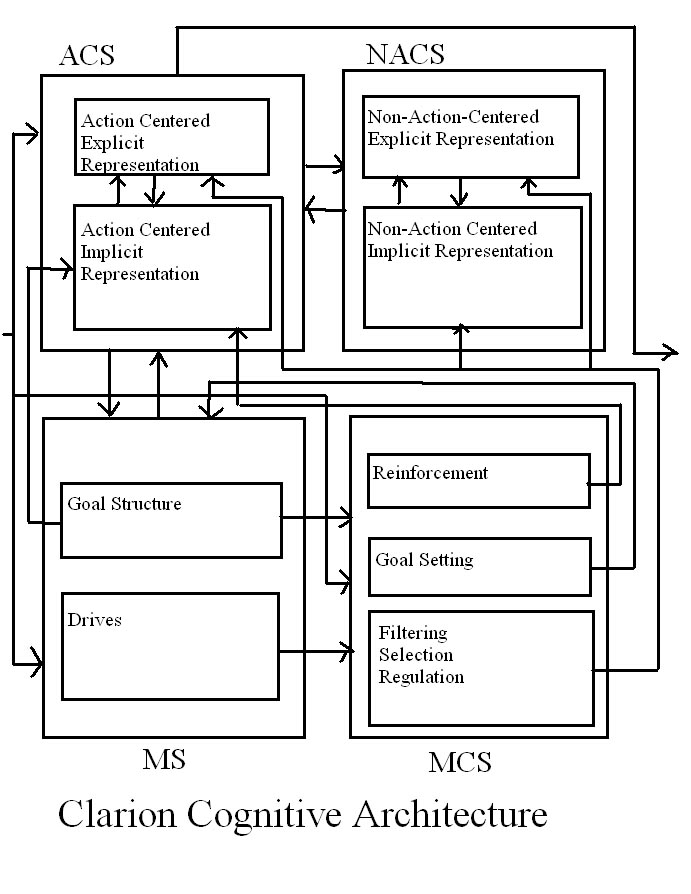
A cognitive architecture is basically a theory to approximate the process of cognition. That is,
if you sort information using these processes then you sufficiently mimic cognitive process.
Clarion does so with the basic assumptions that
a) cognition is always means of fulfilling motivation
b) motivation is either the effect of a drive or a goal structure
c) action and knowledge-bank both operate two separate processes, implicit and explicit (which I think are better called intuitive and declarative)
It should be directly stated that this is not literally true. The following subsystems are not associated with specific regions of the brain whose job it is to perform them. These are complex and loosely penned cognitive processes that are not comprehensive but are sufficient to approach cognition. If we better understand our cognitive process then we are more readily able to recognize hang-ups and solutions especially in regard to how we structure our learning.
The illustration looks much more complicated than it actually is. Let’s look at each subsystem.
- The kickstarter of cognition is the Motivational Subsystem. You start with a drive. Cognition itself is specifically designed as an instrument to fulfill this drive. It can range from food, water, or avoiding danger, to autonomy, dominance, recognition, or belonging, etc. We are pretty familiar with this kind of psychological assumption. You may also be motivated by a process created by a goal structure that in turn services a drive. That's fortuitous for us, since we want to use our natural tendencies to procedural ends and like goal-setting anyway.
- All explicit knowledge constantly cycles through Meta-Cognitive Subsystem. Meta-cognition is simply monitoring and direction. At this stage, your brain decides what is appropriate to do. The MCS filters, selects, and regulates information to be acted upon. It reviews progress, reinforces positive processes, and sets goals to solve for unsatisfactory processes.
- The Action Subsystem controls thought/action. It has an explicit and an implicit level that operate simultaneously.
- Non-Action Subsystem maintains your knowledge-bank. It has explicit and implicit resources.
- Explicit: declarative, specific, more accessible.
Explicit knowledge is representable. It can be communicated easily through words, symbols, or named concepts. In a melee context, all knowledge is procedural, a rule for action. I like the term Declarative because it can be and very often is declared.
- Implicit: intuitive, holistic, fundamental, less accessible.
Implicit knowledge is not representable. It is automatic and outside of our verbal grasp. Colloquially we sometimes hear it referred to as Unconscious but in this context that’s extremely confusing. I prefer Intuitive.
We can now discuss the two learning processes suggested by the model and its researchers.
Top-Down
Learning principles to apply to action. The design is placed before the experience. This knowledge is either heard and then internalized through practice in its application OR it is intentionally sought out in experience, then sorted. Anything that is or can be “worked out.” This is the method that is most familiar to us as an educational model. It is on the whole very efficient. A Top-Down approach is weak in two meaningful respects. First, the knowledge is only as good as how well it is understood. A limitation in understanding is an immediate limitation on knowledge and capacity. Second, this knowledge is limited by the capacity of its delivery. If the words fail to sufficiently address the situation then the knowledge fails to sufficiently address the situation.
Bottom-Up
Trail and error to arrive at unconscious mastery. The experience is placed before the design. This knowledge is necessarily out of reach of our conscious meta-cognition and thus poorly understood if understood at all. In this way it is almost entirely built from experience. The best example of this is grammar. Although we can learn grammar using declarative rules, most of us learn a language at too young an age to use them. We internalize the correct rules of grammar through a huge amount of trial and error. We have an acute intuitive sense for these rules but it is extremely difficult for us to formulate them on demand. Intuitive knowledge is incredibly profound, capable of magnificent complexity, and effortless to put into use—we rarely even notice. However, it is obscenely inefficient. Running yourself through the trails and errors required to assuredly arrive at correct intuitive knowledge is a monstrous task. It is also highly susceptible to misdirection by biases in interest/activity/wrong opinion/etc.
But the beauty of the dichotomy lies in the overlap. These models are not mutually-exclusive. Because they operate simultaneously, a conscientious learner can actively take advantage of both. He may gently guide the progress of his bottom-up learning with focus and mindfulness or later conceptualize the solutions that he intuitively arrives to as if by accident. This is the optimized form of Bottom-Up. He may intentionally internalize his top-down assumptions with practice, allowing a methodology to sink into an unconscious procedure that is more sensitive to exceptions. This is the optimized form of Top-Down.
Monday, August 22, 2016
Two Types of Approaches
Two Types of Approaches
In the following article I will discuss how human reaction time can be accounted for in terms of spacing and approaching to create a dynamic system of offensive option coverage. I will be pulling examples from Mango's tournament matches to best illustrate how a good approach game is much more intricate than "always doing nutty options in your face."
Unreactable Range
Before we can talk about designing effective approaches we have to discuss the ramifications of human reaction time. Humans have a natural lag in their response time caused by the mechanics of the brain sorting information. Because visual information is somewhat complex and the electrical signals go through several steps before they are comprehensible, an average response to visual stimuli is about .25-.3 seconds (15-20f). Because it requires less processing, your response to audible stimuli is faster, averaging at about .17 seconds (10f). Additionally, reactions are additive. If there is visual and auditory information your reaction speed should increase slightly, even more so with regular and focused practice. However, it should be noted that these estimates are for simple reactions in which there is only one possible trigger and response. Complex reactions in which there are multiple possible triggers and responses are significantly slower, although your exact reaction time will vary considerably depending on a) the complexity of the situation and b) how practiced your response is. It is possible with dedicated practice to reduce your reaction in replicable scenarios such as in punish game to under 18f, allowing for something like consistent reaction techchases with Sheik or Falcon.
I suggest checking your personal levels at
http://cognitivefun.net/test/16 (simple audio)
http://cognitivefun.net/test/1 (simple visual)
http://cognitivefun.net/ (tests tab for more complex scenarios)
Applying this temporal limitation to the neutral game, we run into an interesting spatial problem. In every matchup, there is an invisible range that, once passed, prevents you from being able to cover options on reaction. Some players refer to this as an “attack bubble” or “range of effectiveness” or something similar but to preserve a clear distinction between the full spatial range of a nair and the range at which you can no longer react to and shield/CC a nair, I’ll call the latter the unreactable range. Using an estimate of 20f (this number can and should be individualized for personal levels) for a reaction, the outer limit of the unreactable range is located at exactly where a given character can have an active hitbox after 20f plus the startup time of whatever your reaction is. Keep in mind too that this range can change with relative frame advantage. If a character is experiencing 15f of endlag then they obviously can’t begin to move for 15f, reducing the unreactable range. If you are in lag then that range may effectively increase. When making decisions from within the unreactable range, you accept that you cannot account for all options on reaction and are in essence making a guess. When making decisions from outside of that range, you accept that with good execution you can react to anything that happens.
Understanding and recognition of the unreactable range allows for a very useful model for approaching in two variations.
Type 1: Incremental Approach
In this approach, you aggressively move forward to the very edge of the unreactable range, then you stop.
Because for the entire length of this approach you maintain your capacity to react to any counter-measures by the opponent, it is completely safe. But because you are rapidly closing space, this movement is still hyper-aggressive and frequently prompts some kind of response by your opponent. By your design their impulsive response is reactable and can net you a large punish on top of the ample stage control.
The incremental approach is most difficult when your opponent decides to run at you at the same time. When this happens the space between the characters closes extremely quickly and it is more difficult, though still possible, to stop/shield/DD at the correct spot.
Examples:
Mango(Falco) vs Mew2King(Marth)
Mango(Puff) vs Scar(Falcon) note the very precise and consistent location where mango shields/starts his jump. Mango will often flash shield to stop in place when an incremental approach is his intention.
Mango(Fox) vs Hungrybox(Puff) at 0:40, 1:18, 3:10, 3:41, 7:48, etc
Type 2: Running Mixup
In this approach, you aggressively move forward into the unreactable range and initiate a mixup. An approaching mixup should be specifically designed to cover options. For example, a Fox can mix up between running shine (beats shield and in place options), deep nair (beats a WD/dash away/jump) and a WD back (beats an attack). A fox that actively chooses between those three approaching options can beat most of his opponent’s options. He can alter this set of mixups as the MU or the player demands, but this is the rough design. It is as close as melee gets to rock paper scissors, and a player that frequently initiates mixups is either a) confident that he can consistently out-guess his opponent in an unreactable situation based on past interactions and outpunish off of trades or b) stupid.
Examples:
Mango(Fox) vs Taj(Marth)
Mango(Fox) vs Hungrybox(Puff) at 1:14, 1:32, 1:40, 2:21, 2:35, 2:52, etc
Just as Type 2 requires the Fox player to actively mix up his approaches to avoid being predictable, so too does approaching as a concept require a player to actively mix up between types 1 and 2. A player that never enters the unreactable range never actually presents a real threat when he moves forward and can be advanced on and poked without any fear, defeating the purpose of incremental approaches. A player that never stops short of the unreactable range is not making good use of his stage control and and can be easily beaten by a strong defensive game with good risk reward from the corner. In order for either type to maintain effectiveness and good risk reward for the attacker, the threat of the other must be present and respected.
In this way, the concept of approaching once again reiterates the importance of strong footsies.
In the following article I will discuss how human reaction time can be accounted for in terms of spacing and approaching to create a dynamic system of offensive option coverage. I will be pulling examples from Mango's tournament matches to best illustrate how a good approach game is much more intricate than "always doing nutty options in your face."
Unreactable Range
Before we can talk about designing effective approaches we have to discuss the ramifications of human reaction time. Humans have a natural lag in their response time caused by the mechanics of the brain sorting information. Because visual information is somewhat complex and the electrical signals go through several steps before they are comprehensible, an average response to visual stimuli is about .25-.3 seconds (15-20f). Because it requires less processing, your response to audible stimuli is faster, averaging at about .17 seconds (10f). Additionally, reactions are additive. If there is visual and auditory information your reaction speed should increase slightly, even more so with regular and focused practice. However, it should be noted that these estimates are for simple reactions in which there is only one possible trigger and response. Complex reactions in which there are multiple possible triggers and responses are significantly slower, although your exact reaction time will vary considerably depending on a) the complexity of the situation and b) how practiced your response is. It is possible with dedicated practice to reduce your reaction in replicable scenarios such as in punish game to under 18f, allowing for something like consistent reaction techchases with Sheik or Falcon.
I suggest checking your personal levels at
http://cognitivefun.net/test/16 (simple audio)
http://cognitivefun.net/test/1 (simple visual)
http://cognitivefun.net/ (tests tab for more complex scenarios)
Applying this temporal limitation to the neutral game, we run into an interesting spatial problem. In every matchup, there is an invisible range that, once passed, prevents you from being able to cover options on reaction. Some players refer to this as an “attack bubble” or “range of effectiveness” or something similar but to preserve a clear distinction between the full spatial range of a nair and the range at which you can no longer react to and shield/CC a nair, I’ll call the latter the unreactable range. Using an estimate of 20f (this number can and should be individualized for personal levels) for a reaction, the outer limit of the unreactable range is located at exactly where a given character can have an active hitbox after 20f plus the startup time of whatever your reaction is. Keep in mind too that this range can change with relative frame advantage. If a character is experiencing 15f of endlag then they obviously can’t begin to move for 15f, reducing the unreactable range. If you are in lag then that range may effectively increase. When making decisions from within the unreactable range, you accept that you cannot account for all options on reaction and are in essence making a guess. When making decisions from outside of that range, you accept that with good execution you can react to anything that happens.
Understanding and recognition of the unreactable range allows for a very useful model for approaching in two variations.
Type 1: Incremental Approach
In this approach, you aggressively move forward to the very edge of the unreactable range, then you stop.
Because for the entire length of this approach you maintain your capacity to react to any counter-measures by the opponent, it is completely safe. But because you are rapidly closing space, this movement is still hyper-aggressive and frequently prompts some kind of response by your opponent. By your design their impulsive response is reactable and can net you a large punish on top of the ample stage control.
The incremental approach is most difficult when your opponent decides to run at you at the same time. When this happens the space between the characters closes extremely quickly and it is more difficult, though still possible, to stop/shield/DD at the correct spot.
Examples:
Mango(Falco) vs Mew2King(Marth)
Mango(Puff) vs Scar(Falcon) note the very precise and consistent location where mango shields/starts his jump. Mango will often flash shield to stop in place when an incremental approach is his intention.
Mango(Fox) vs Hungrybox(Puff) at 0:40, 1:18, 3:10, 3:41, 7:48, etc
Type 2: Running Mixup
In this approach, you aggressively move forward into the unreactable range and initiate a mixup. An approaching mixup should be specifically designed to cover options. For example, a Fox can mix up between running shine (beats shield and in place options), deep nair (beats a WD/dash away/jump) and a WD back (beats an attack). A fox that actively chooses between those three approaching options can beat most of his opponent’s options. He can alter this set of mixups as the MU or the player demands, but this is the rough design. It is as close as melee gets to rock paper scissors, and a player that frequently initiates mixups is either a) confident that he can consistently out-guess his opponent in an unreactable situation based on past interactions and outpunish off of trades or b) stupid.
Examples:
Mango(Fox) vs Taj(Marth)
Mango(Fox) vs Hungrybox(Puff) at 1:14, 1:32, 1:40, 2:21, 2:35, 2:52, etc
Just as Type 2 requires the Fox player to actively mix up his approaches to avoid being predictable, so too does approaching as a concept require a player to actively mix up between types 1 and 2. A player that never enters the unreactable range never actually presents a real threat when he moves forward and can be advanced on and poked without any fear, defeating the purpose of incremental approaches. A player that never stops short of the unreactable range is not making good use of his stage control and and can be easily beaten by a strong defensive game with good risk reward from the corner. In order for either type to maintain effectiveness and good risk reward for the attacker, the threat of the other must be present and respected.
In this way, the concept of approaching once again reiterates the importance of strong footsies.
Subscribe to:
Posts (Atom)